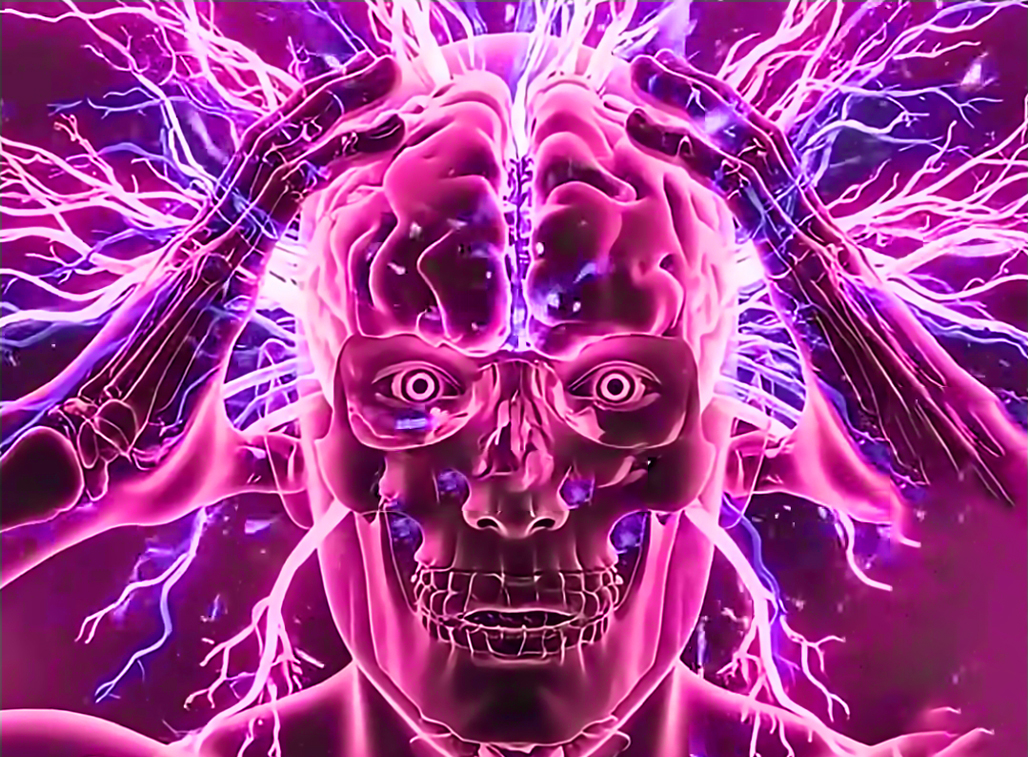
Stepping into my fine art shoes for something completely different.
Have you ever wondered why magenta doesn’t appear in the rainbow? It’s not because you missed it. It’s because it’s not really there—at least, not in the way colors like red or green are. Magenta is what scientists call a non-spectral color, which means it doesn’t have a wavelength of light associated with it. In fact, magenta isn’t a color that exists in the physical spectrum of light at all. It’s something your brain makes up.
Let’s break that down.
The Science of Seeing Color
To understand why magenta doesn’t exist in the real world, we need to take a quick dive into how humans perceive color. Our eyes contain cells called cones that detect different ranges of light: red, green, and blue. These cones send signals to the brain, which then interprets combinations of them as colors.
For example:
- When red cones are stimulated, you see red.
- When green and red cones are stimulated together, you see yellow.
- When all three are stimulated, you see white.
Now here’s where it gets interesting.
The Color Spectrum Has Limits
Visible light is made up of a continuous spectrum of wavelengths ranging from about 380 nanometers (violet) to 750 nanometers (red). Every color on the spectrum corresponds to a specific wavelength. Blue has a short wavelength, red has a long one, and green is somewhere in between.
But notice something missing? There’s no magenta.
If you look at a rainbow or a spectrum created by a prism, you’ll see red, orange, yellow, green, blue, indigo, and violet. Nowhere in there is magenta. Why? Because there’s no single wavelength of light that corresponds to magenta. It isn’t part of the spectrum. It’s not a real color in the physical sense.
Magenta: A Brain-Born Illusion
So what happens when your eyes are exposed to both red and blue light—but no green? There’s no wavelength in between red and blue (they’re on opposite ends of the visible spectrum), so your brain is in a bit of a bind.
Instead of panicking, your brain does something clever: it invents a new color.
Rather than showing you both red and blue at the same time, or leaving a confusing gap, your brain constructs a color that doesn’t actually exist in the outside world. That color is magenta.
In technical terms, magenta is an extra-spectral color—a color the brain synthesizes from the simultaneous stimulation of red and blue cones, with very little or no green cone stimulation. It’s the mind’s way of resolving a paradox. Your brain essentially says, “I don’t know what this is, so here’s something that feels right.”
Why This Matters
Understanding magenta helps reveal a deeper truth about color itself: color is not a property of light alone—it’s a product of perception. The world doesn’t come pre-colored. Your brain is actively interpreting sensory data and making educated guesses.
Magenta is a perfect example of this mental magic trick. It’s not “out there” in the world like red or blue light—it’s “in here,” inside your head, a beautifully convincing illusion.
So Is Magenta Real?
It depends on how you define “real.” Magenta might not exist as a wavelength of light, but it’s certainly real in your experience. It’s a manufactured color, but that doesn’t make it any less meaningful. In fact, it makes it all the more fascinating.
Magenta is a reminder that not everything we see is a direct reflection of physical reality. Sometimes, what we perceive is a creative interpretation—an elegant solution to a sensory puzzle.
Final Thought:
Next time you see magenta—in a flower, a neon sign, or your favorite shirt—remember: it’s a lie your brain lovingly tells you. And isn’t that kind of amazing?
Hope you enjoyed this unique look at color, brought to you by science!